


The HRS Group was founded in 1981 and is a global leader in technology and heat treatment. It offers cutting-edge, energy-saving solutions for heat transfer around the globe.
If you require information or equipment from the HRS Group, you can contact us and we will answer your questions and resolve your doubts.
What HRS heat exchangers have to offer.
The company’s systems and equipment have been used in heating, ventilation, air conditioning, water treatment, energy, food preservation, and waste treatment industries for more than four decades.
HRS heat exchangers are available in several types, such as gasketed or welded plates, shell and tube, corrugated tube, and scraped surface.
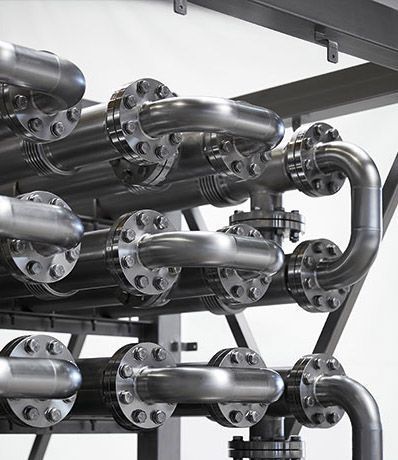
HRS develops, improves, and heaters, evaporators, and reactors that are assembled in all types of heat exchangers. Innovating in this field allows HRS for energy savings, a decrease in waste and CO2 emissions, and an enhancement in the final product’s quality without affecting the environment. When designing its heat exchange equipment, it follows the rules of the European Pressure Equipment Directive, especially when using tubes with curved surfaces.
The products of the company are classified into three primary sections or groups, based on the outcomes that are intended to be obtained:
Corrugated tube heat exchangers
By using advanced corrugated tube technology, HRS has been able to transfer heat more efficiently than the most common smooth tube heat exchangers. Also, this design makes it less likely for the heat exchanger to get dirty, which makes it smaller and cheaper to make. HRS has a wide range of stainless-steel equipment, with models adapted to different industries. It is capable of devising customized solutions and utilizing diverse materials in accordance with the distinct prerequisites of each application.
Some key advantages offered by its corrugated tube heat exchangers are as follows:
- Higher heat transfer capacity compared to conventional designs.
- Significant reduction of fouling problems.
- Lower operating expenses due to improved efficiency.
- A small size that fits in almost any space.
HRS Heat Exchangers is positioned as the ideal partner for any organization seeking highly efficient and reliable heat exchanger solutions due to its proven expertise and constant focus on innovation.
HRS double-pipe heat exchangers

The design of double-pipe heat exchangers, a highly efficient heat transfer solution, is characterized by the placement of a concentric tube inside a larger tube.
For viscous products, the double-pipe is particularly suitable. HRS Heat Exchangers offers double-pipe heat exchangers, adapted to different applications and needs. Some of the most important are the following:
Hygienic double-pipe heat exchanger — HRS DTA Series
Designed especially for the food industry, the DTA Series of double-pipe heat exchangers feature a corrugated inner tube that significantly improves heat transfer. Due to their corrugation technology, these heat exchangers offer higher thermal efficiency compared to conventional smooth tube models, while minimizing fouling problems.
The integrated bellows are designed to absorb the differential expansion between casing and tubing, and multiple units can be interconnected for larger-scale applications. It can be mounted in insulation, frame or with a stainless-steel casing. The HRS DTA Series is especially suitable for viscous food products such as honey, fruit jams and marmalade.
Double tube heat exchanger for industry — HRS DTI Series
The DTI Series of tube-in-tube heat exchangers, made of stainless steel, is designed for industrial applications. The product flows through the inner tube, while the service fluid flows in a countercurrent flow between the inner tube and the casing. Due to their corrugation technology, these heat exchangers offer higher thermal efficiency compared to conventional smooth tube models, while minimizing fouling problems.
A bellows can be added to absorb the differential expansion between the outer and inner tube, and depending on the case, it is possible to add another bellows to mitigate differential expansion. These units can also be interconnected and mounted in a rack.
Insulation and stainless-steel cladding are also options.
The HRS DTI Series is ideal for applications involving fluids with fibrous components or other solids, as well as medium-to-high viscosity fluids.
Double tube heat exchanger — HRS DTR Series (allows removal of the tube from the inner side)
The DTR Series heat exchanger is based on the DTI Series. It is intended primarily for sludge, slurry, and wastewater treatment. The extra benefit is that you can take off the tube on the inside to check everything more closely. It is the ideal solution for heat recovery.
HRS Multi-tube Heat Exchangers
Shell and tube heat exchangers are equipment that use multiple tubes to transport the product, both for heating and cooling purposes. The exchangers are made up of inner tubes that carry the product to be treated, while the service fluid moves through the surrounding shell.
A wide range of heat exchangers is offered by HRS, including industrial, exhaust gas, food applications, direct recovery for food, multi-pass, hygiene, industrial, and pharmaceutical.
Annular space heat exchangers
On the other hand, the annular space heat exchangers of the HRS AS series consist of three concentric tubes made entirely of stainless-steel. In this design, as mentioned above, the product flows through the inner tubes, while the remaining fluids move through other channels.
The outstanding feature of these exchangers is that they have a removable inner tube, which allows a thorough inspection of the product in the annular space.
Corrugated tube technology is more efficient than smooth tube heat exchangers. And it should be noted that they get less dirty.
The heat exchanger is equipped with an expansion joint to absorb the expansion difference between the shell and the annular space. In the case of larger equipment, several units can be interconnected and mounted on a frame, which can be enclosed with stainless-steel sheet metal.
The HRS AS annular space heat exchangers are available in the following models:
- HRS AS 3 series.
- HRS AS 4 series.
Scraped surface heat exchangers
HRS Heat Exchangers also makes and sells scraped surface heat exchangers, which are used in situations that need special solutions because of two problems.
When dealing with viscous fluids with low heat transfer rates, the accumulation of dirt can cause a decrease in heat transfer efficiency.
Fouling in heat exchangers and viscous fluids
The accumulation of dirt in HRS heat exchangers is a considerable challenge in the field of heat exchange. This issue arises when fluids undergo degradation near the internal surface of the pipes, resulting in the formation of solid deposits in the form of layers or adhesions on the walls. These layers act as insulators, hindering heat transfer and decreasing the overall performance of the exchanger. In addition, there is another type of dirt accumulation known as crystallization, which occurs when fluid components solidify and deposit on the exchanger surface due to changes in temperature or concentration.
To maintain high heat transfer efficiency, it is essential to remove these deposits, and this is where scraping the heat exchanger surface plays a crucial role.
In the case of viscous fluids, an inverse relationship between viscosity and heat transfer efficiency is observed. As a fluid becomes more viscous, its ability to transfer heat is reduced. Therefore, in situations where highly viscous fluids are used, considerably larger heat exchange areas are required. The scraped surface heat exchangers mix the fluid with energy and thus avoid the aforementioned problem. This mixing helps transport the fluid efficiently to and from the exchange surface, which significantly increases heat transfer rates and reduces the area needed to perform the heat exchange.
HRS Solutions
HRS Heat Exchangers offers tailor-made solutions for applications that present difficulties in terms of heat transfer, such as high viscosities and dirt accumulation problems. The preferred option in these cases is the scraped surface heat exchanger, which maintains high heat transfer rates and ensures that the heat exchanger surface is constantly clean.
Two scraped surface technologies are offered by HRS to its customers: the HRS Unicus Series, which employs a circular motion, and the HRS R Series, which employs a circular motion. Each of these technologies has been designed for specific applications, ensuring efficient solutions tailored to the particular needs of customers.
HRS Plate Heat Exchangers
Plate heat exchangers are used when the viscosity is low and there are not too many particles. Furthermore, they are perfect when the outlet and inlet temperatures are similar.
These heat exchangers are composed of thin, corrugated plates, which are compacted and arranged in a frame, either by packing or copper brazing. The plates are pressed against each other and are housed within the frame, while the product flow circulates through alternate channels and the service flows between the product channels.
The plate heat exchanger developed by HRS has been designed for easy maintenance and inspection. It is composed of a series of individual plates with a pressure-engraved herringbone pattern. Because the spike pattern is in opposite directions, multiple points of support are generated, forming a network in each channel and achieving a high level of turbulence. This design allows a high heat exchange coefficient to be achieved.
Types of plates in heat exchangers
HRS Heat Exchangers specializes in the design of plate heat exchangers that are tailored to specific heat exchange requirements. These exchangers are equipped with two types of plates, known as high and low theta plates, which vary in thermal length. This wide variety of sizes allows for greater versatility. The combination of both types of theta plates offers a highly efficient and cost-effective solution. They feature a flexible design that allows the construction of multisection units. These units are composed of two or more sets of plates, separated by pressure plates or C-plates. This modular configuration facilitates assembly and provides greater flexibility in terms of adapting to different heat transfer requirements.
Some typical applications for HRS plate heat exchangers include liquid heating, steam heating, fluid cooling and heat recovery in various industrial processes.
History of Exchanger Industries Limited
The company was born in Alberta, Canada, in 1961 and has extensive experience in engineering, designing, manufacturing and servicing heat transfer solutions for challenging applications. Its primary objective is to provide customers with cost-effective investment and operational solutions through practical heat transfer designs in various applications. Exchanger Industries Limited has customers in Canada and 25 other countries. They have skilled workers and use new technology to make their products cheaper and use less energy. Their products last longer and don’t need much maintenance.
The HRS Group comprises of these companies, along with several others, which operate manufacturing facilities in our nation, the United Kingdom, and India.
Most important milestones in the history of HRS
In 1981, HRS was established as a specialized supplier of heat exchangers for energy recovery and process systems, thus establishing the foundation for its focus on thermal technology.
In 2001, a joint venture was established between HRS and a major Indian company, allowing them to enter the Indian market and expand their international presence.
In 2004, the company was established in Phoenix, Arizona, and reached the United States.
In 2006, HRS Process Systems Ltd was started in India. They had their own facilities and started working in 2007.
Over the next decade, HRS continued to expand in different regions of the world. It established its presence in Malaysia in 2011, with the opening of HRS Heat Exchangers SDN BHD, to serve the Southeast Asian market.
Last years
In 2014, HRS opened a branch office in Australia and New Zealand, known as HRS Heat Exchangers Pty Ltd. as a base for sales, projects and technical service in the region.
In the same year, it established a joint venture with the Russian company Hi-Prom Bureau to introduce its products in the Russian market, thus consolidating its presence in Eastern Europe.
HRS continued its expansion in the Americas, opening a commercial office in Atlanta, Georgia, in 2015, and establishing an office in Mexico in 2016 to meet the growing demand in the Latin American market.
HRS Heat Exchangers SLU doubled in size in Spain in 2017.
In 2018, HRS Process Systems Pvt Ltd turned over Rs. 1 million shortly before opening a second site in this geographical area of South Asia.
HRS launched AHED (Advanced Heat Exchanger Design) in 2020, an innovative heat exchanger design solution. In 2021, Canada-based Exchanger Industries Limited, a world-renowned manufacturer of heat transfer solutions, acquired HRS Heat Exchangers Ltd (HRS), further strengthening HRS’ position in the global market.
Articles related to heat treatment and steam technology
You may be interested in some of the articles below.
- How the steam trap mechanism works
- Steam pressure reducing valves
- Positive displacement pumps
- Steam trap operating problems
- Our selection of the best steam traps
- How to prevent water hammer in steam pipelines
- Seditesa, official distributor of TLV in Spain
- Scraped surface exchangers
- The best industrial steam filter
- What is steam used for?